

Footage of the Eagle landing on the moon’s Sea of Tranquility on July 20, 1969 shouldn’t be suspenseful. After all, we know the result—the moment is one of mankind’s greatest achievements. And yet I couldn’t help but lean in from my bench, on proverbial pins and needles, as the scene approaches in The Moonwalkers, the latest, and arguably most extraordinary, immersive exhibition at South Florida PBS Studios in Boynton Beach.
This is almost entirely an effect of the production’s marvelous storytelling, accomplished through place-setting sound effects, emotive music—the producers hired an entire Bulgarian choir to assist with the score’s cinematic pathos—and visuals edited for maximum clarity and effulgence. We feel the churning rumble of the rocket as it ascends from Kennedy Space Center. We sense the palpable anxiety from Mission Control in Houston as its scientists manage the myriad moving parts necessary to make history. And our hearts swell with pride and satisfaction upon those immortal four words: “The Eagle has landed.”
Many in my audience of 51 that attended The Moonwalkers on a recent Sunday afternoon broke into applause at this point, unusual for a documentary that was only about 35 minutes into its running time. It’s easy to become choked up at these moments, even with the critical distance I always apply to art that I’m reviewing. I found myself unexpectedly emotional—nostalgic for a world event that I, having been born in 1982, never got to experience.
You might say The Moonwalkers climaxes early, but its focus is not just on the Apollo 11 moon landing. It opens with astronauts from the current Artemis II program waxing poetically about their pioneering Apollo forbears, which leads into footage of John F. Kennedy’s famous speech at Rice University outlining his vision for the United States as a spacefaring society. Then, astronauts—members of the fortunate 12 Americans who have walked on the moon—discuss the overview effect of observing Earth from a cosmic vantage.
Following the Apollo 11 portion, the story continues with videos and stills from the five additional Apollo moon missions—the great discoveries their travelers made and the distances they explored: a mountain on the moon that could contain Mount Fuji, a chasm the depth of the Empire State Building. We watch as an astronaut drops a hammer and a feather simultaneously on the moon’s surface, and we gasp as both land on the rocky terrain at the same time. And we share in the joy of the astronauts’ downtime as they skip, jump, and throw things.

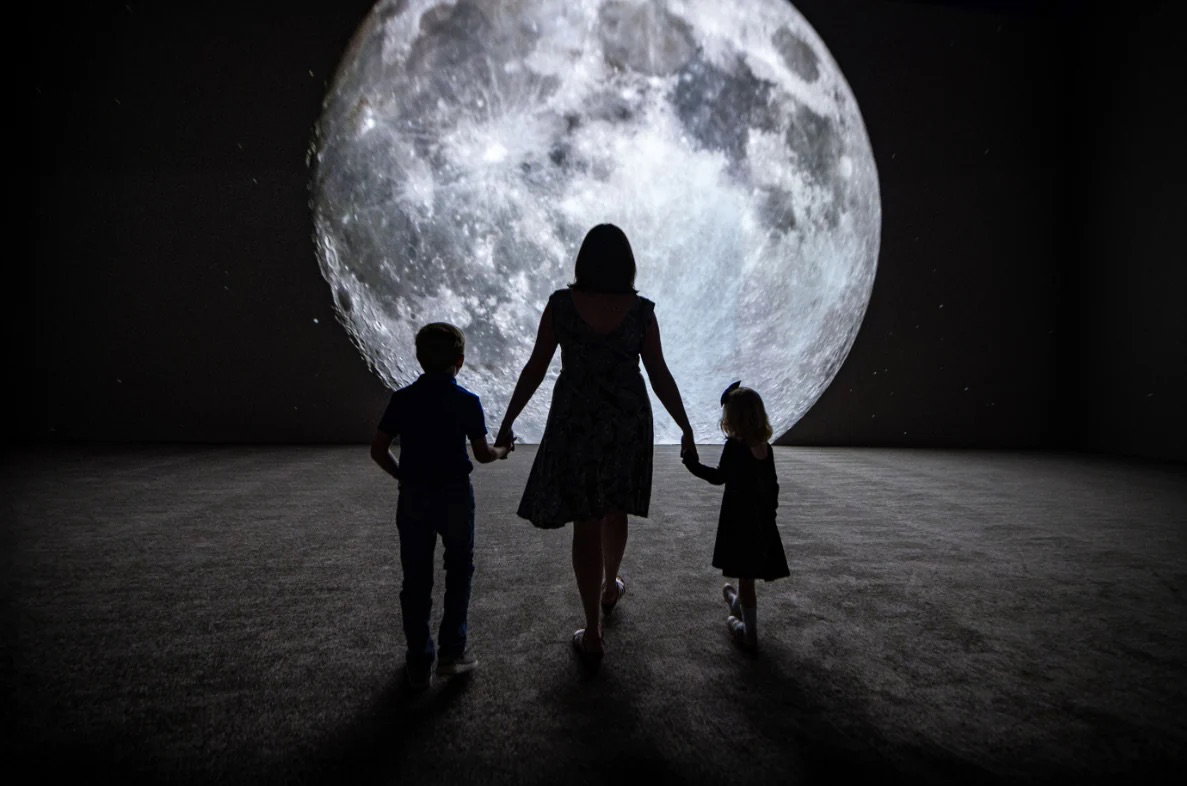
But to some extent, what you take away from the experience will depend on you, and where you look. Given the importance of the subject matter, The Moonwalkers is appropriately overwhelming; it’s hard to contain it within the four walls of the studio’s exhibition space. And so images project onto all four surfaces, and sometimes on the floor beneath our feet.
Photos, names, diagrams, and other data appear in flashes and vanish soon thereafter. Their power is in the sheer multitude of them—some 10,000 photos were taken on the moon—rather than their individuality. There is a prismatic quality to the show, our eyes endeavoring to absorb a dozen or more images at once. At one point, the entirety of the room becomes consumed by the abstract art of moon rocks in hues our rainbows cannot capture. But the producers also know when to scale back, as when everything disappears but for a news broadcast from Walter Cronkite, its small, boxy format mirroring how viewers from across the country and the world learned about this singular feat.
And, at the risk of burying the lede any futher, the show has Tom Hanks as its narrator. With his folksy, sometimes singsong delivery, he leans into his status as America’s everyman—our most trusted source, for all things space and otherwise. No matter how far out The Moonwalkers can be, Hanks returns every now and then, not only to dispense facts but to ground the action with his personal history, as when he discusses his childhood simulating the effect of floating in space by bobbing in the waters of his family’s above-ground pool.
The production itself is only part of the experience. Visitors to The Moonwalkers have much to see and explore prior to the show’s beginning. For 20 minutes before the advertised showtimes, ticketholders can take pictures with a replica of the Eagle and enjoy an interactive room where they can “chat” with an AI astronaut, take digital photos of themselves in astronaut gear, design their own lunar missions, view a model of Neil Armstrong’s Apollo 11 gloves, and spend a couple of minutes in a VR simulation of Mission Control.
Collectively, this production and all of its bells and whistles remind us that while we live in a challenging and stressful time, so were the 1960s, and look at the unifying moment that culminated the decade. The Moonwalkers is enough, if even for just a moment, to defuse our cynicism, erase our differences, and allow us to revel in the greatness of human ingenuity.
The Moonwalkers runs at South Florida PBS Studios (located at 3401 S. Congress Ave., Boynton Beach) through March 30, 2027.
For more of Boca magazine’s arts and entertainment coverage, click here.