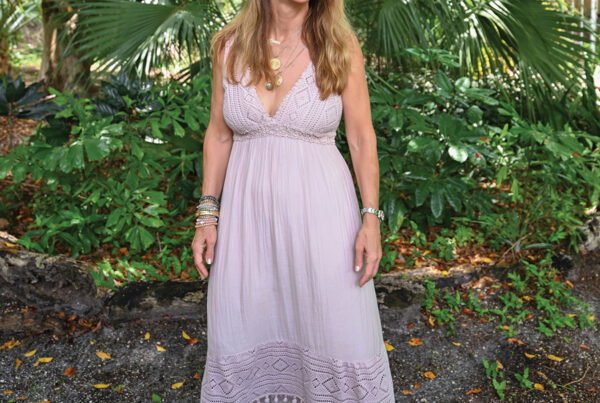

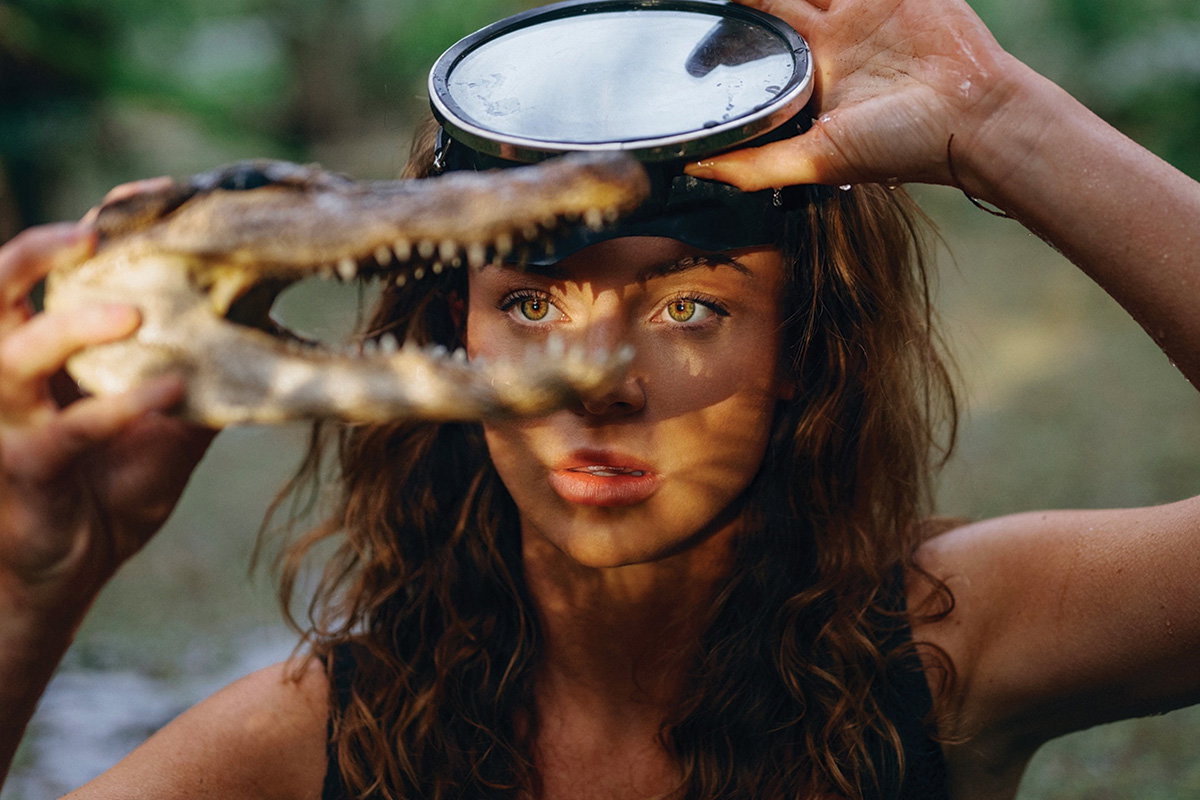
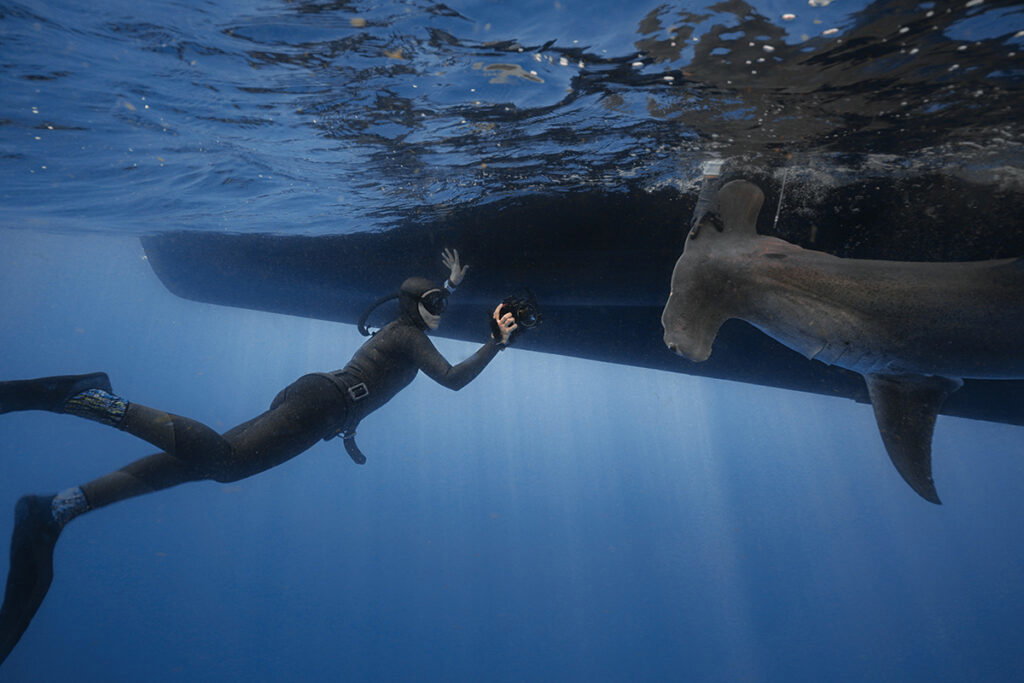
Swimming with sharks did not come innately to Rosie Moore. As she recalls, her first experience shark-diving, at age 12, was precipitated by a sleepless night. “I thought for sure I was going to die,” she recalls. “Then, obviously, you do it, and everything’s totally fine.”
These days, Moore’s professional life as a wildlife biologist often involves close proximity to sharks—she’s even bopped her head against one—as well as alligators, snakes, and other potentially fearsome creatures in Florida and beyond. A native Missourian who first began diving in her state’s rock quarries, Moore moved to Delray Beach to attend Florida Atlantic University, graduating from the Boca Raton school with both her bachelor’s, in General Studies, College of Science, and her master’s, in Geological and Earth Sciences/Geosciences, class of 2020.
Since 2023, Moore has been a television presenter for the Discovery Channel, where she discusses shark science, and has appeared on networks as varied as ESPN, Fox News Channel, CNN, and History. In 2025, she was selected among four elite teams of shark divers in the debut season of Netflix’s All the Sharks, a series whose participants compete to photograph as many as sharks and rays as possible in locations such as the Maldives and the Bahamas. Outside of her more public-facing work, Moore is a citizen science manager for the International SeaKeepers Society, a Florida-based oceanographic research and conservation nonprofit.
Moore, 29, also has a devoted following on TikTok, where she documents her myriad adventures in the wild to some 120,000 followers, from swimming amid the “sunken city” of Deep Dive Dubai, with its record-holding 197-foot pool; to revealing a bite from a Burmese python; to accepting a marriage proposal during an 8-mile Everglades hike. Some of her videos have accumulated upwards of 14 million views.
Last year, she published her first book, Forged by Florida: Rosie’s Guide to Florida’s Wildest Adventures. When she not’s chasing adventure around the world, Moore maintains her Delray Beach address.
What’s the scariest situation in which you’ve found yourself?
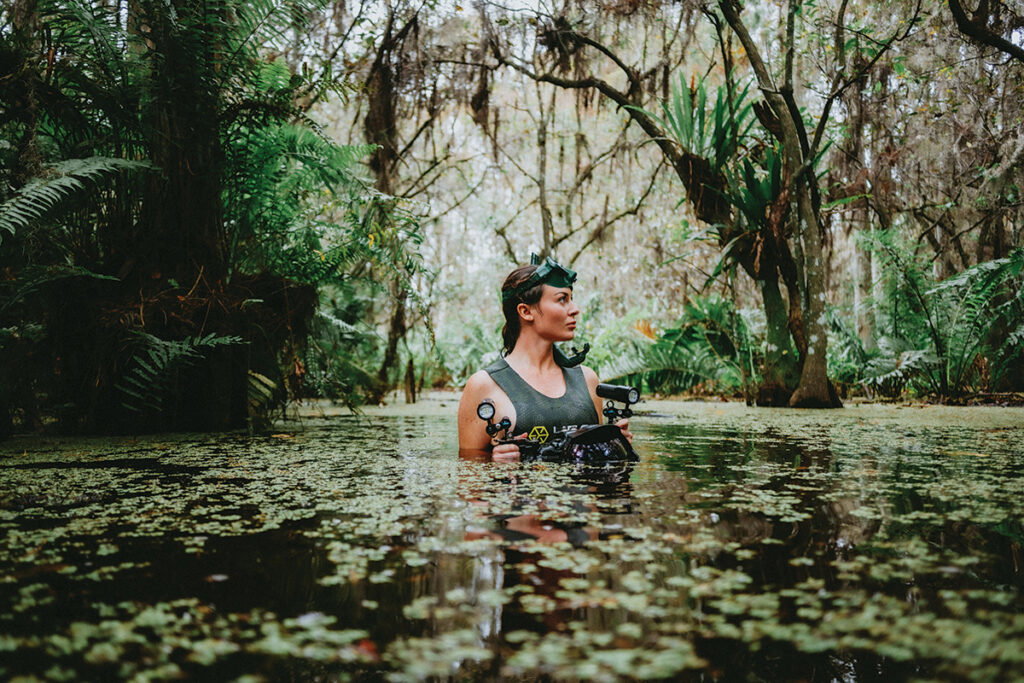
Definitely night diving with alligators. I did have a situation where I was watching one alligator and actively filming it in probably 10-foot-deep water, and another one started charging me off the side. So my head was half in the water, half out, and I heard rustling in the branches next to me in the Glades. And I looked over, and it was coming for me.
What you do in that situation is we have these big Nauticam housing setups, so you do something called feeding it your camera. It’s what I do with sharks, too. If you see one that’s coming at you, as you put the dome, or housing, towards the gator or shark, they’ll go for that first, and it’s pretty sturdy. They are these rigid metal housings. So you do that, and they’ll give it a test bite, realize it’s not something edible, and will leave.
I understand you contracted dengue fever at one point.
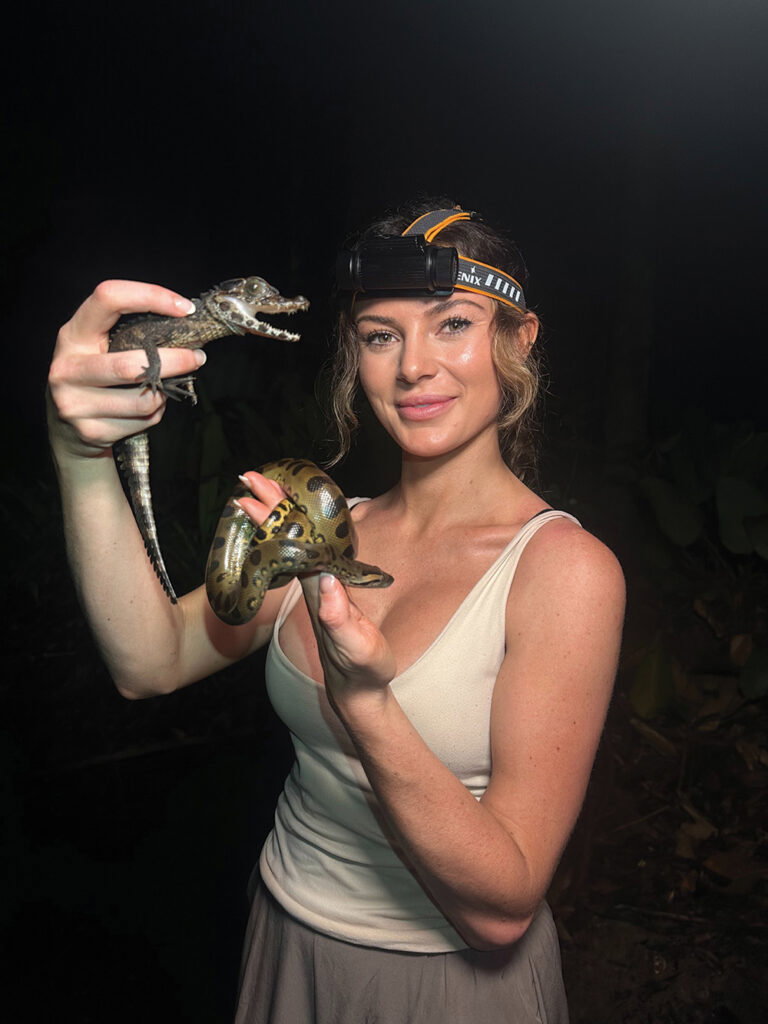
It was the worst experience of my life. We were in Suriname, and it was supposed to be an anaconda expedition. Suriname is super-remote. I had no signal the entire time. We were usually hiking 12 miles a day. And my first symptom was I felt like my eyeballs were being pulled out of my head. You feel this immense pressure behind your eyes everywhere you’re looking. And then I got a really high fever, probably 102, but there’s no hospitals out there, and there’s nothing you can do. So I would still have to hike 12 miles at night to continue on the trek. And I remember drinking Coca-Cola, which I never drink, and eating all these sugary foods, because I felt like I was going to pass out at all times. And I was like, if I don’t drink these sugary, caloric foods, I might die.
So once it started passing finally, your whole body gets this crazy rash, even on the palms of your feet and your hands. By that time, the doctors said, “you’re actually past the main part of it, so you’re fine now. There’s nothing we can do, so you’ve just got to ride it out.” It was definitely a terrible experience.
You performed a necropsy on a Burmese python that made Newsweek. What did you find?
That was crazy. These guys called the lab I was working at. They said, we have this insane python in front of us, and we think it ate a person. And we’re like, “can you send a picture?” I looked at it, and at first glance, I thought, it’s got to be a deer or something. But we weren’t sure. So they brought it to the lab. Obviously, we euthanized it and did the necropsy. And it was a fully intact alligator. The alligator was about 5’2”, so it’s literally the size of me. And the python was over 18 feet.
Was that a record?
It wasn’t a record, but only by a few inches. I don’t remember what the current record is. [A Burmese python measuring a record-setting 19 feet was recorded in Florida in 2023.—Ed.] Anything over 18 feet is absolutely crazy to see in the Glades. It’s a once-in-a-lifetime snake.
What was it like to perform the necropsy?
It was super-gross, and honestly, the smell was insane. We kept running in and out of the room, just to clear our noses, because you have two extremely large decaying animals, specifically the alligator.
Did you come away from this with a new appreciation of what these pythons are doing to the Everglades?
Yeah, and if you think about it, alligators hold their breath for a really long time. So for the python to be able to suffocate it, which is what it does, the power to constrict a full-size alligator is really crazy. And it would do what’s called a red-out too, which is to overpower the brain and basically blow it out by the blood vessels, just from the pressure of constricting.
It seems like you a have unique role as somebody who’s doing this kind of hard science, but you’re also in the pop culture realm, by appearing on many networks and series, and having such a public persona. Why is it important to have your feet planted in both of those worlds?
I think it’s always interesting to do shows on mainstream networks, and also social media, because you do have to be a little bit clickbait-y to get views, or to plant the narratives that the networks push. And that gets people that typically wouldn’t watch an alligator movie or a snake movie to click on it and actually be interested. So you have to ride a fine line of being scientific and not ruining your credibility there, but also being able to make it fun and entertaining to people that don’t typically watch nature shows.
Did appearing on television come naturally for you?
No, I’m actually really shy, and I did not like doing TV at first. I was so nervous my first few live interviews. My first big ones were Tucker Carlson and some Fox News ones, and I panicked, and probably prepped for an entire week; most people just prep for a day for those short interviews. But I wasn’t sure how it worked. I was definitely more stiff and less casual, but the more you are just yourself, the better it comes across on camera. But it has definitely been a learning curve.
What did Tucker want to talk to you about?
I think I did a whale story for him, and it was about whale conservation and how the offshore wind farms were affecting whales. Obviously it was a bit of a political agenda that they were pushing, which I learned after being in media for a while. My policy is that as long as I’m not saying anything political, and it’s the truth when it comes to the wildlife, then it’s fine.
How did the opportunity to appear on All the Sharks come about?
It came about from a producer, Mike Clarkson, who’s a good friend of mine, and he, even though he produces shark television, is a herpetologist. And he is the head of a major herpetology society. So he knew of me and my work through snakes and crocodiles rather than sharks. But originally, he had wanted to make All the Sharks about finding snakes. But it’s harder to get people to watch a snake show than it is to watch a shark show, so instead of it being a snake hunting show, it ended up being a shark show.

The format of the show allows only 10 minutes of time each episode to what you were doing and seeing out there with your partner, despite diving for eight hours a day. How was your overall experience compared to the snippets we saw on the show?
We actually filmed a lot longer than what they showed. I think it was four days in a row of diving, four times a day, plus free dives. So they trimmed it down a lot. What you’re seeing is a cursory, very brief review. We had no idea how it would come out and how they were going to edit it, because obviously the show was never done before. So when we watched it, we were surprised by what they showed and what they didn’t show. Because they also tried to make it very family-friendly, so there were a lot of life-or-death, dangerous situations that happened during the show that they cut out or played down, because we don’t want to scare kids.
Did you face any scares personally?
We had a few mask failures and other things. One [mask] came off at 80 feet, which was really scary, because it was a bottomless dive. You’re just drift diving in the Maldives, so there’s no reference of the ocean floor. So when the mask came off, my partner just started sinking rapidly. We also faced a lot of crazy currents and vortexes, which is something I’d never really experienced before. It only really happens in island territories. So the vortexes kind of sweep you out, and since we weren’t allowed to have a local guide actually guiding the dive, there were two or three instances of people getting swept up in vortexes.
And we were also attacked by Japanese fishermen who didn’t know we were filming a show. They thought we were stealing their fishing spots.
You’ve also spoken on “Shark Week” on Discovery. why do sharks hold such a fascination with people?
I’ve gone about this several ways, because snakes, for some reason … people tell me, “I won’t watch a show if there’s a snake on it.” Whereas sharks, a lot of people seem to like watching shark shows. I think people think that if they walk around outside, you might run across a snake, and it’s a real, credible threat to you. Whereas sharks, especially in middle America, it’s not a daily threat that you face, so it’s easier to consume content or watch things about sharks than it is snakes.

What’s it like working at SeaKeepers?
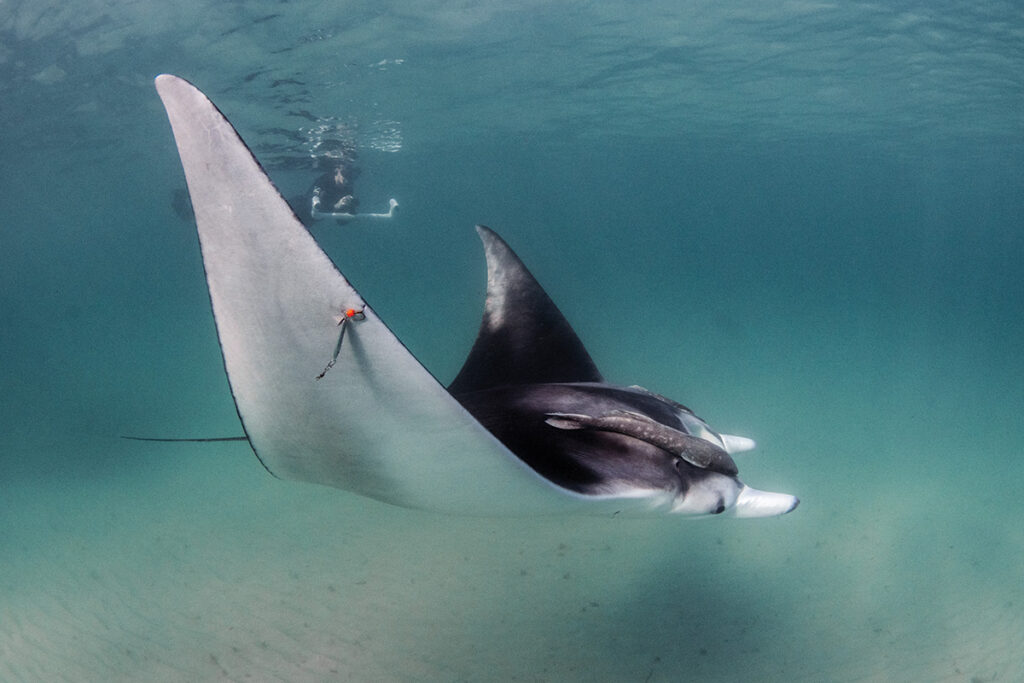
I’m a citizen science manager for the International SeaKeepers Society, so it’s actually really fun. We do two main things—citizen science and scientist-led expeditions. So I get to travel the world, and we basically connect private yachts and private boats with scientists. So it cuts the cost for the scientists to go and do their expeditions. We’ll go around the world, do different things like shark tagging, manta ray research, things like that.
And for citizen science, scientists reach out to us and say, “I need to collect water samples in the Mediterranean to do great white shark research and see if there’s any eDNA [mitochondrial DNA released from an organism into its environment—Ed.] indicating that they’re there.” And then we’ll find the boats around the world and in the Med, and we’ll collect those samples and give them back to the scientists. So it cuts the cost of them having to go collect the samples for themselves.
Is this the kind of position you imagined for yourself with your degrees?
I never even knew this was a possible job, but it’s definitely really fun, and it lets me dabble in a variety of research from around the world instead of being hyperfocused on one topic, which is a huge bonus.
You also wrote a book, Forged By Florida, on your favorite wild adventures across the state. What is
a top destination to observe local fauna here in Palm Beach County?
Palm Beach County is huge for me. Wakodahatchee Wetlands, especially during main nesting season, is insane—all the birds you can see right off the side. I used to do wood stork research when I was at FAU, so all the baby wood storks there … I think it’s an incredible experience.
What most troubles you right now about conservation in Florida; where should the alarm bells be going off?
I think invasive species are a huge one. We have more invasive reptiles now than native reptiles. A lot of the attention gets put on Burmese pythons, but Argentine black-and-white tegus are everywhere now, and those are super-alarming, because they eat anything that’s ground-nest
This story is from the September/October 2026 issue of Delray magazine. For more like this, click here to subscribe to the magazine.