
In the paintings of Gertrude Abercrombie, is an owl just an owl? An egg just an egg? A lighthouse just a lighthouse?
We can’t deign to know the exact answers to these and many other recurring symbols in the late bohemian painter’s four decades of work. The joy of engaging with her art lies in interpreting the unknown, the obscure, the gnomic. There’s a reason her blockbuster retrospective at the Norton Museum of Art (running through March 14) is titled “The Whole World is a Mystery.”
The exhibition is the first nationally touring presentation of Abercrombie’s art, a remarkable fact considering the long shadow she casts on American culture, from the surrealist movement to the macabre humor of Edward Gorey to the advent of modern jazz. (Growing up in Chicago’s fertile jazz scene, she befriended the genre’s key players and considered her paintings as visual allegories to their improvisatory bebop playing.) Yet it’s often the lot of the singular modernist to achieve their highest fame posthumously. She only received her first major museum retrospective shortly before her 1977 death, and just last month, an estate sale picker bought an original Abercrombie for $30 and flipped it for $1.35 million at auction.
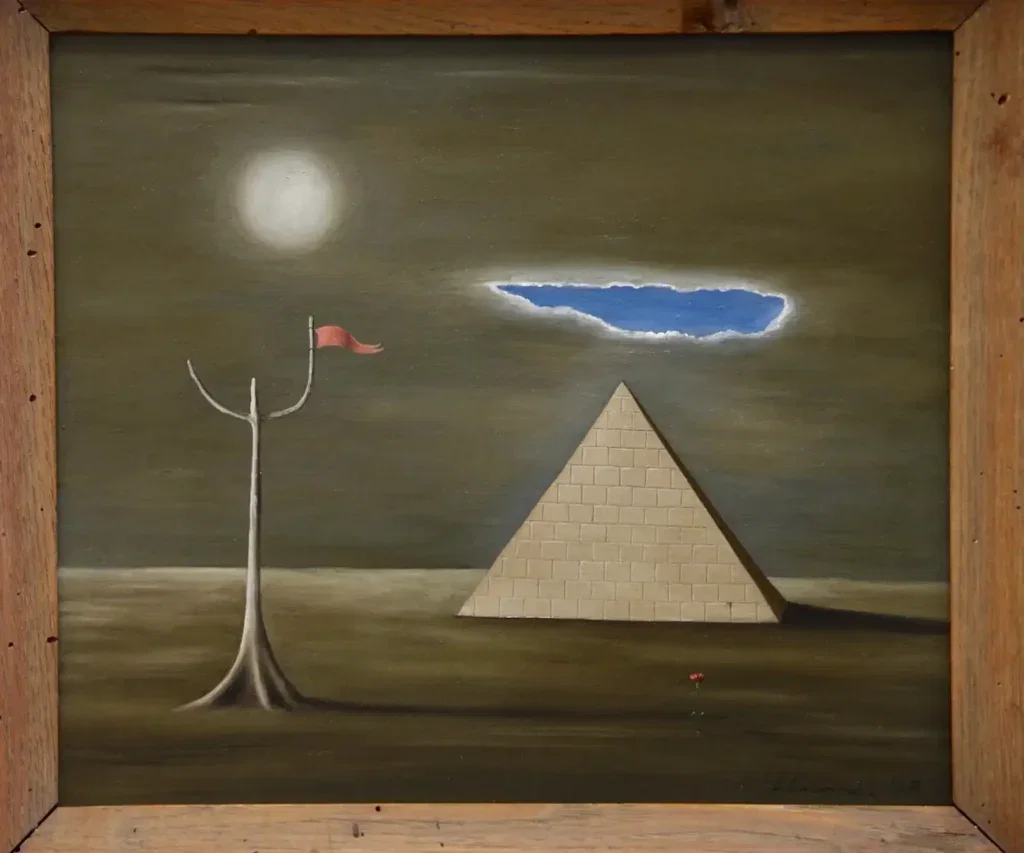
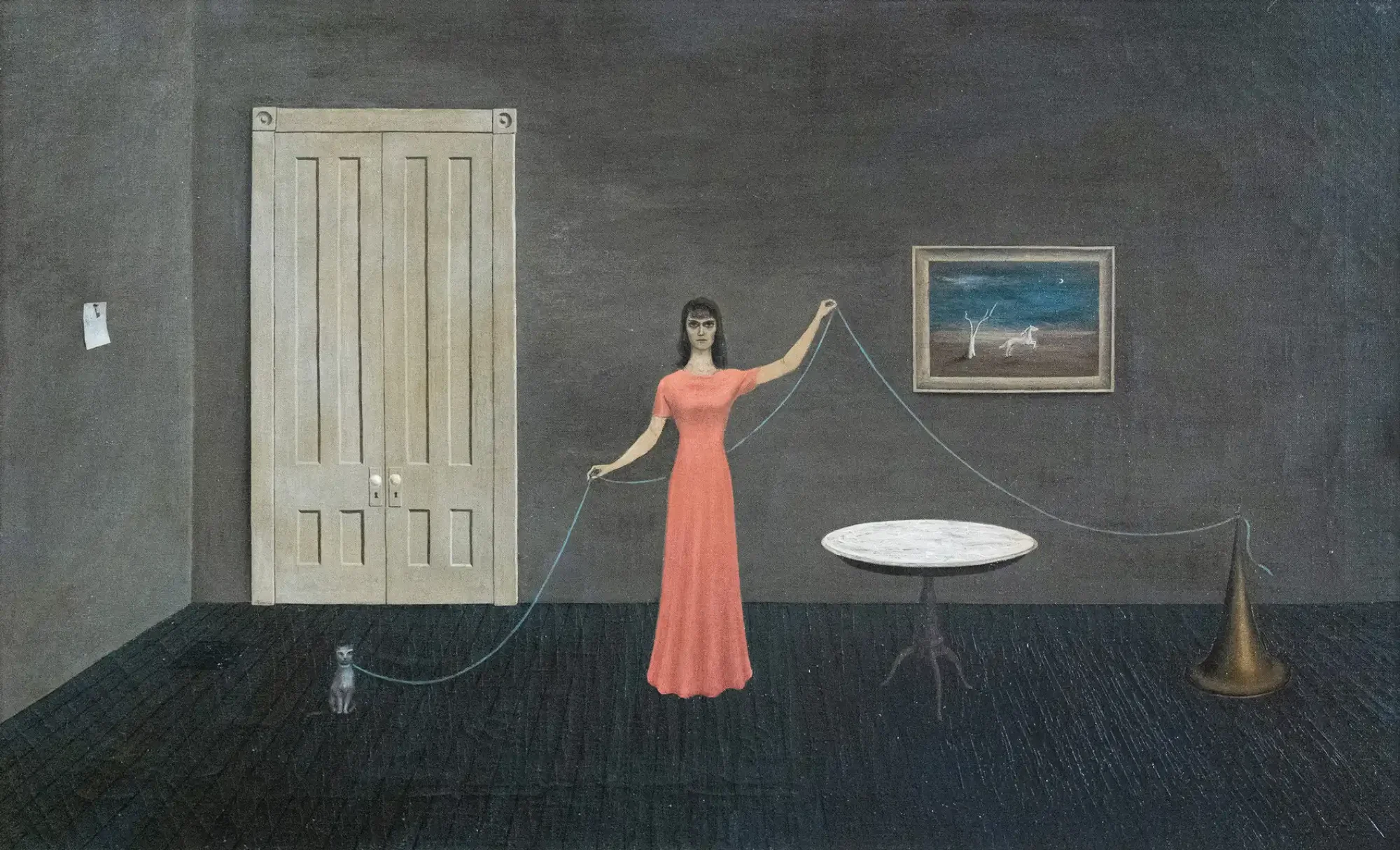
So “The Whole World is a Mystery” arrives at an opportune time for a renewed interest in her work, and it serves as a welcome immersion into her weird world, a place recognizable in the broad but peculiar in the specifics. She painted landscapes in which the trees are barren and spooky and anthropomorphic, their jutting limbs endowed with personality. Her clouds were slits and slivers, most of them pancake-shaped, hovering like flying saucers over eerily placid vistas. Her interiors were as bare as her nature scenes—rooms with maybe single parlor table bearing a vase or a top hat, a door without a hinge, perhaps a cat shadowing a corner, the walls cracked and occasionally exposing the brick foundation underneath. They don’t look remotely lived-in; these are the spaces of dreams or stage sets in some experimental play arranging itself in their creator’s head.
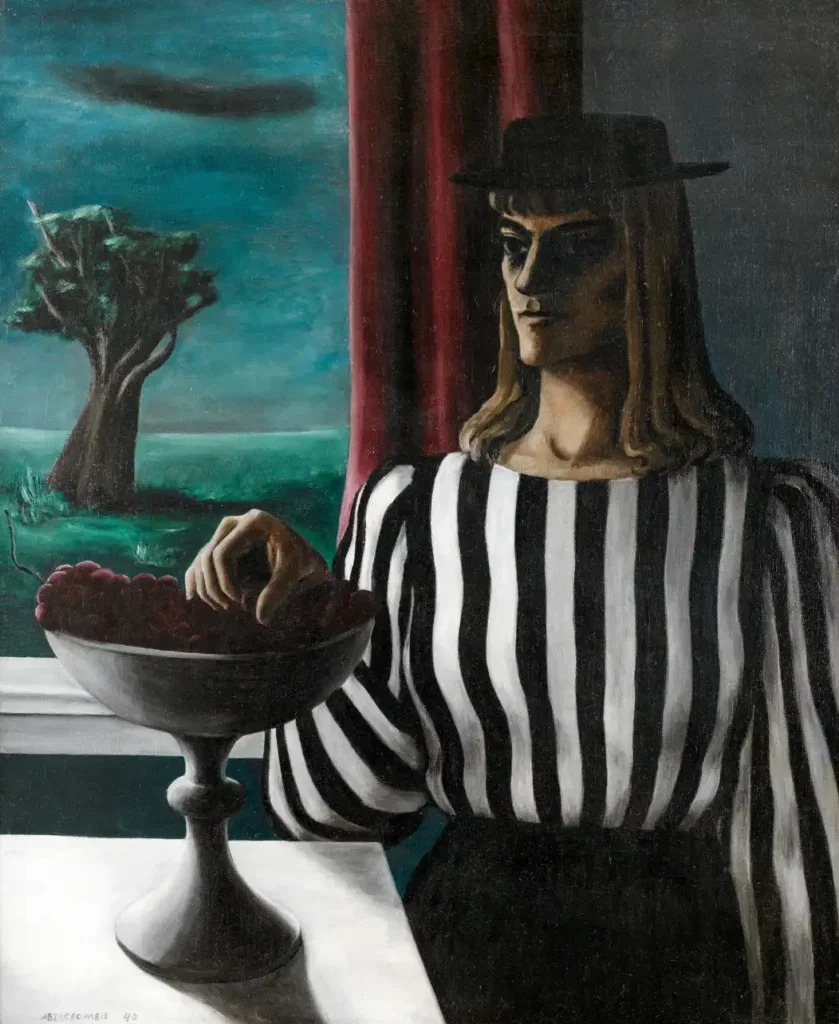
She often appears in her work, usually dressed in sepulchral black. She identified herself as a “good witch,” and noted that all of the women in her paintings are, in fact, herself. Though she painted a formal self-portrait—in which she appears in front of heavy red curtains, another allusion to the theatricality of her approach—her on-canvas avatar is best represented in paintings like “The Church,” a marvel of perspective in which she appears in the foreground, carrying a dead tree limb like an offering, and gazing at the title building far in the distance. Whether she is approaching the church as a heretic or a believer is one of the show’s myriad mysteries.
Sometimes, as in “Ivory Tower,” she situates herself like a princess in a Grimm Brothers fairy tale, appearing almost indistinctly from the top of the tower, leaving us to judge if she’s pampered or imprisoned. “The Chess Game,” in which she materializes on one of the red-and-black chessboard squares alongside trees, owls, and other enigmatic figures, may indicate a clue; in this case, she is merely a pawn in some cosmic game.
Time and again, her level of control or agency come into question, especially when men share the frame. In “The Courtship,” a man in a masquerade mask—a mystery within a mystery—points at her on a beach, his index finger shaped like a gun. Abercrombie’s avatar looks at him askance, her hands up. In “Mysterious Stranger,” she comes across as a spinster barely visible in the background of a tiny house, the path from her abode shining like a searchlight that hits on the title character. Is he a suitor or a threat? Relationships, in Abercrombie’s work, are fraught with as much ambiguity as her still-lifes and landscapes.
Yet there is also much humor in “The Whole World is a Mystery,” and more than a modicum of paranormal juju. She is a halved person in “Split Personality,” as if a blade bisected her midsection, her front half floating away of its own accord. In possibly my favorite painting of the exhibition, “Cats, Screen and Ghost,” the tail and head of a cat appear on either side of a dressing screen, like a magician’s trick. An apparitional form of Abercombie’s silhouette looms over the other side of the frame, complete with cane and witchy fingers, forever destined to haunt the artist’s own bespoke spaces.
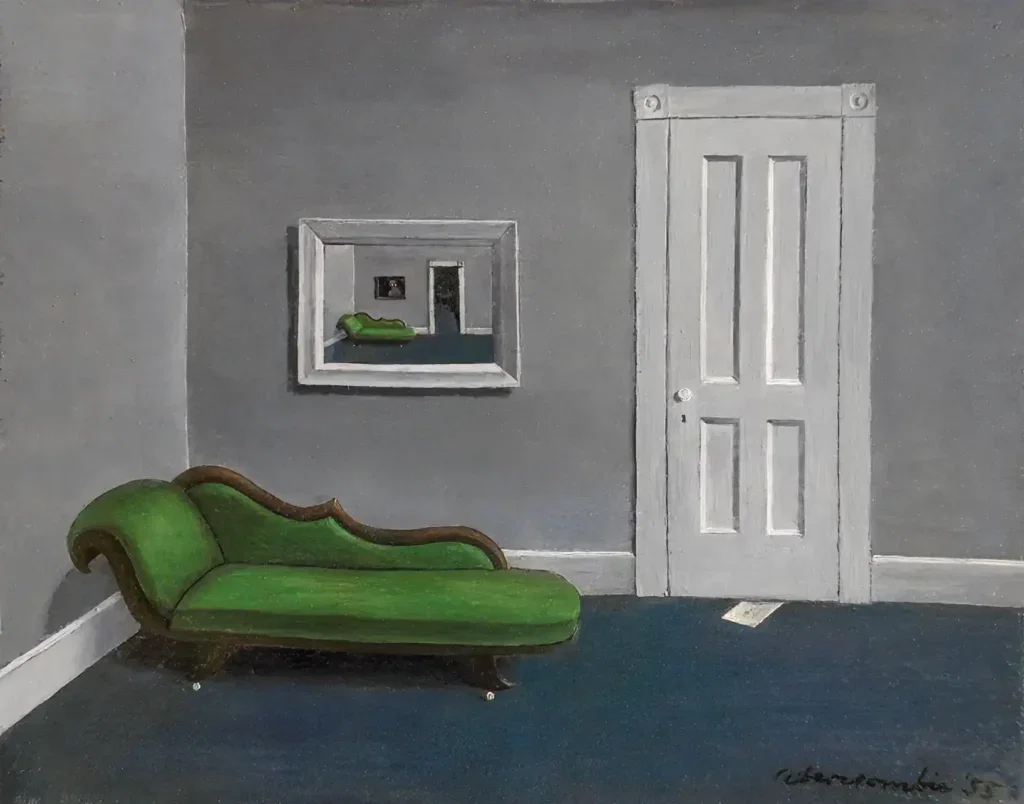
But Abercrombie is always present, even which she doesn’t appear. She was nothing if not a pioneer of meta, with miniature versions of her paintings appearing on the walls of larger scenes as pictures within pictures. Sometimes, these micro paintings are like cracked mirror images of the primary painting—similar but not exact replicas, with details askew, like variants from some parallel universe, all of it clearly ahead of its time.
“The Whole World is a Mystery” is perhaps best appreciated as an ever-splintering nexus of esoteric connections and motifs referencing and doubling back on themselves, rewarding close reading. Like complex jazz recordings that gather coherence only with repeated listening, we’re not expected to “get” her oeuvre on our first experience with it. Luckily for us, the exhibition is running for another four months, with fresh wonders to behold in every visit.
“The Whole World is a Mystery” runs through March 14 at Norton Museum of Art, 1450 S. Dixie Highway, West Palm Beach. Museum admission is $20 general and $17 seniors. Call 561/832-5196 or visit norton.org.
For more of Boca magazine’s arts and entertainment coverage, click here.